On Temple Cleaning
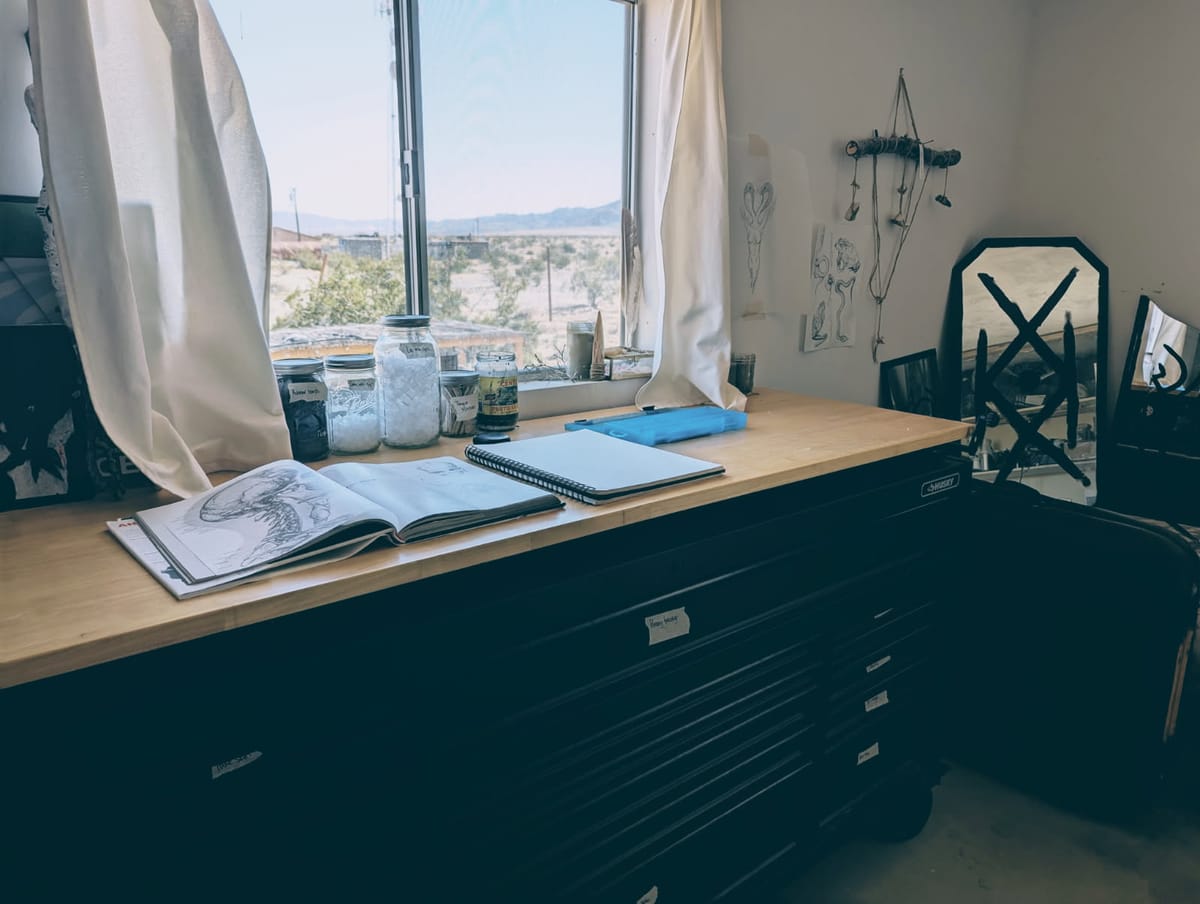
I've been fretting about releasing another post on this site for a few weeks now. My intention was to release another in the Entheogens series, and I've been doing lots of research on Amanita Muscaria to provide the best pharmacological breakdown of that very popular and yet often misunderstood fungi friend. However, my own relationship with substance has been fraught this year. For one, I haven't really been doing any, and it feels almost fake to dissect the spiritual use of something I really don't... use anymore for my Practice. It just is not the season, though I do think I'll have more to say come summer, as summer is the season for such things as we're forced to become more nocturnal, and therefore to fill that time with a different kind of Practice.
However, something that has been on my mind for a great while now, ever since the beginning of the collapse of our commune here is what I call temple cleaning. I am stealing this term, actually, from someone who wrote a book under the name Touch Fucking Moonflower (I hope they don't mind, I believe they're likewise borrowing the term from Zen practice) about their own community's spiritual Practice. Several things about this book and the Practice it describes touched us as being resonant and aligned with our own, but one thing in particular I hadn't ritualized before reading it was temple cleaning: or really, the act of maintaining one's space. While I'd always oriented to organization and cleanliness in a reverent way, I'd never really thought that this was a part of my spiritual practice, and had kind of accepted the insistence of some of my less organized artistic friends that I was just a little neurotic.
But my partner was once a student of Butoh, and there is something there from Zen Buddhist traditions wherein each movement in a sequence (be that a performance, or, as the Zen monks, the passage of a broom across a floor) is ritualized. Butoh becomes then a kind of physical meditation, wherein the focus is on the movement and control of one's body, not necessarily on one's mind – though obviously that follows. He introduced me to Butoh by taking me along to a workshop or two when we lived in Los Angeles together many years ago, and so when I read in Touch Fucking Moonflower's book their description of temple cleaning and its harkening back to Zen temples, well, something became clear.
The keeping of space is so important to me partially because at times I've had no space. The control of body is important to me because for much of my life I felt I had no body: that it belonged inherently to other people (the details of which are complicated and won't be shared here). The space we steward now is so sacred to us, because in part it is where we create and Practice, and in part because we finally have a safe, stable space in which to provide that to our children and guests.
And so we ritualize cleaning in a way that it has kind of always been ritual: before guests come, before Wheel of the Year rites or celebrations, before in-depth phases of meditative or spiritual work. Though now we name it as such.
Resistance to Care
One reason why this has been on my mind so much lately, and one angle I wish to introduce it through is that of resistance. When we were hosting guests here who we thought were going to become permanent or at least long term members of our on-site community, something happened that perhaps you all saw coming but which we were taken aback and shocked by:
We said "make this your home", and our residents were gleeful to consume and partake in what was offered (and sometimes what was not offered). But when we said "make this your home", we also said "treat it like your own home", which did not happen. Or, perhaps, it did, if we assume that most people tend to disregard their space in general. It hasn't been long since we lived with roommates, so we know. I suppose we believed that when we were forming a commune based on spiritual practice and land stewardship, there would be an inherent desire of the people interested in both to maintain the sanctity and organization of this shared space.
However, I've understood since that both the assumption that we were creating a commune based on shared spiritual practice and dedication to land stewardship and the assumption that if the former were true the members would inherently revere this shared space were false. The first was false because of a misunderstanding on our part: we perhaps projected our own dedication onto those who tangentially shared our values, which was unfair, because we were excited about the prospect of combining efforts and holding space for people who needed it. The latter was false because, as I've come to understand it through reflection and discussing this with others: there is a kind of fundamental rejection of care that is, I think, pervasive in our culture. Even if the former assumption had been true, it would not have necessarily followed that reverence for space or orientation to our land and home as sacred would be inherent or shared in the same way.
Despite that occasionally ethics of care will be verbalized as an ideal, I think that it's rather hard in a rigorously individualistic and materialistic society to actually learn what it is to care – be that about oneself, one's space, about others, or about the spaces shared with others. I feel quite lucky because I think one reason this comes easily to me is that I was raised by a mother who cared a lot about everything: about us, about our home, about other living beings. For any of her faults, one thing she taught us was the primacy of maintaining our space before doing anything else. Whilst as a teenager it was frustrating to clean the house before going out, and while many people act when I share this bit of my childhood that this was the peak of child abuse (I suppose exposing their own entitlement and privileged upbringing in the meantime), I think this lesson was incredibly important[4].
For why should we not first and foremost, clean our temple? What other business can truly be attended to if our own sanctuary is disordered?
On Discipline and Cleaning Up
There are parallels, I've learned, between those who cannot stomach doing the dishes and those for whom spiritual practice is a proverbial minefield. For paramount to any spiritual practice[1] is discipline. I understand: we live within oppressive external structures, and the concept of discipline has, at times, been weaponized. However, whatever your initial dismissal of the concept of discipline, it still is necessary, as I've discussed before. Let's hold this here for a moment, we're going to return to it.
One reason why specifically the orientation to our space is so important is because, in psychological terms, the way we keep our space is often reflective of the way we maintain ourselves or at least view ourselves. Whether or not you represent yourself as being incredibly confident and self-assured, if your space is a disaster and you allow yourself to live with rotting food on week-old dishes in the sink (for example), I know that however you project yourself, you think very little of yourself in reality. Even where neurodivergence, mental illness, or the excessive busy-ness of poverty makes common domestic tasks more taxing or difficult, I have always found that those who value themselves still find ways to maintain their spaces.
This is not to claim that the aforementioned factors and oppressive social structures that make maintaining one's space at times painful or extremely difficult are to be upheld because "if you just value yourself enough you'll make the time". Obviously we must work towards cultivating societies and spaces where we can support one another enough that the cleaning of one's space or shared spaces is not incredibly painful. All I am attempting to convey in the prior paragraph is that if you don't even try, it is very likely that there is an underlying reason that goes beyond just mental illness, neurodivergence, or poverty (and quite honestly these things are all related: where poverty makes someone feel worthless, or powerless, this usually shows up in how they keep their space, and the same goes for mental illness or neurodivergence).
There is a two way relationship here, then. A vital way to reclaim our sense of personal power or worth is to start with reclaiming our power over our space. When a friend comes and cleans for us after a personal tragedy, for instance, it often gives us the sense that, first of all, we are supported in community; and second of all, we are worthy of having a nice space within which to heal. So if you are one of those people (as are some of my dearest friends) for whom constant disarray are common because of a coalescence of factors that lead you to feel like "fuck it, who cares if my place is dirty", try spending one weekend cleaning up, perhaps with friends, and see how you feel when using the space afterwards. Maybe the following week you can do it at your friend's place, and allow reciprocity to provide a grounding force for the reclamation of shared power. I have a hard time imagining you wouldn't feel invigorated coming home the next day to a cleaner place, that your mind wouldn't feel cleared and you more capable of performing what you wish to perform in the space[2].
This brings us back to specifically spiritual discipline: where you cannot overcome the factors that make you unwilling to do the dishes or mop your floors once in a while, or put away your things, you are very unlikely to be overcoming the distractions of your phone, or that video channel, or relational drama in your life, and so on in order to do magick. If your life is generally in disarray, that is usually a signal that your internal state is disarray and that you are not really ready to engage in Practice beyond the superficial, socially acceptable aesthetic way.
Perhaps this seems harsh, but this is an excellent realization to have: if you deem yourself a quite spiritual person or a practitioner of magick at the very least, but you feel called out by this, there's an easy place to start:
Just clean your room. Your house. Sweep your balcony, take out the trash, open the windows, dust really thoroughly, clean your altar: and let this all be a kind of meditation. Practice focusing deeply on what you're doing each step of the way. How do you feel? Identify feelings of resentment, of I'm too good for this or I'm frustrated that this isn't being done for me. Within these feelings may lie feelings of abandonment, or entitlement you have yet to name and reckon with. Perhaps there are class aspirations within your feelings that misalign with your politics, and these can be overcome and considered more deeply. Identify feelings of despair, of this is way too much and I'm scared I won't do a good job. Focus through them: one step at a time. Do what you can. Little by little. Right now you aren't tackling everything, just this one task, right in front of you: wiping the windowsill, or putting a single dish away. Let it take days if it must, or a single hour every weekend until you've reached every corner. Within those weeks you will undoubtedly feel more pressed to put your things away when you come home and wipe up after yourself in the kitchen, lest the cleaning project go on forever.
If nothing else, there is value in training yourself to do things even when they are difficult. This discipline is vital for any and all action: magickal acts, political action. Part of attainment is mastery over oneself. This is crucial.
Your Space as Temple
Coming back now, for a moment, to the purpose: we are not just learning to clean for the sake of learning to clean, and the discipline we are learning is not discipline for its own sake. We must remember that the point of this discussion is temple cleaning.
We orient to our home as our temple. Perhaps you have an apartment, or a room share, or a bed at a shelter, or only a vehicle. Whatever the boundaries of the space where you live, especially if you also create there, pray there, Practice there, eat there, that is your Temple. That is the space that most directly influences your mental state and the results of whatever Practice you are engaging in: we ignore this at our own detriment. Likewise the other spaces we spend our time: our school, our workplace, the roads we travel, the sidewalks we walk, we can and perhaps should orient to these spaces as an extension of our Temple, and treat them accordingly. Would you allow for trash in your monastery? Then perhaps as you walk down the sidewalk, you should pick up things others have discarded. No matter that it is not a mess you made, or that it will continue to be made again and again, such distinctions are trivial.
When we lived in Oakland, we cleaned the house we lived in. We were just two people of ten, and no one else bothered to clean any of the shared spaces[3]. The landlord had someone come once a month, but 10 people sharing 1200 square feet make quite the mess, and things needed to be cleaned, and so we did so. We never complained about it, nor asked anyone else to do it. This was our home, and so we cleaned it. It was not humbling, nor were we concerned about the optics of seeming "lower class" than the other housemates. We cleaned because we wished for our space to reflect the spiritual discipline we were seeking, and because it was Practice.
My eldest daughter and I often take walks out into the desert, carrying with us a six gallon pail, and we fill it with whatever trash we find. It becomes a shared ritual, and we know that we do it because even though we cannot control whether or not people continue to pass through and leave detritus, the cleaner it is the less likely it is to be left a mess. Such is the psychology of people who are not in Practice.
In this way, the cleaning of the Temple becomes an offering, and a meditation. Like Butoh, we can take our time to be fully present in each and every motion required to put things back in their place, to scrub, to sweep. There is a dance, a ritual, and we offer our labor to that which we venerate as an offering, a demonstration of our devotion. I cannot imagine being within a space to create, to live, or to pray, and not taking great care to ensure it is left clean and honored. And if you find yourself at the center of a great mess, and life feels chaotic and impossible to navigate, perhaps there is a place to start:
Perhaps it is time to clean your Temple.
Notes
- Read: not necessarily religious practice wherein sometimes, as is the case in Christianity, religious authorities are tasked with the disciplined efforts of speaking with God and if only you show up once in a while that's enough. This is not true of other religions, though: Islam expects adherents to maintain more discipline, as does Catholicism, and adherents to both of the latter examples would benefit from the discipline discussed herein, though adherents to the former may think it unnecessarily strict. However, for most of my readership who practices magick in any form, the insertion of discipline into their practice is vital: we don't have clergy to interpret Will for us, and we are also working with very integral forces much more closely than the average religious adherent in the 21st century.
- When I say "clean" it is relative. Objectively speaking, we have the same aversion as all other animals to avoid living in our own filth in terms of rotting food waste or feces, because our biology knows that disease risk is inherent in those types of messes. The same goes for living with cockroaches or rodents: our aversion to these things indoors is biological, not just psychological or socialized -- our bodies recognize disease vectors and feel disgust as a result. This is why seeing a mouse or rat outside often doesn't lead to the same kind of revoltion as seeing one indoors. However, beyond the kind of cleanliness that is likely to lead to good health, we all have different tolerances for or preferances towards minimalism vs. cozy clutter and so on, and for this I would say: be very, very honest with yourself about what you want in your space. I have friends who like very tight, close spaces and have designed their house accordingly, with different little mini-rooms for different activities. I wouldn't say that they need to go "open concept", but things like making sure the cat litter doesn't stink and the dishes aren't making a rotting mess in the sink and the trash isn't always overflowing onto the floor are pretty universally recognized as things that should be done to "keep a space". I, personally, care less if things are dusted than some, but I always ensure that shelves that contain dishes stay dusted and free of cobwebs or the insects that gravitate to and then die on the kitchen lights, and that if anything is dusty enough to start to accumulate cobwebs or dead flies it must be cleaned immediately (and has gone far too long). Floors and kitchen surfaces are, for me personally, non-negotiable: any crumb out here in the desert attracts fire ants and I refuse to share my house with them, and I likewise refuse to allow food residues to accumulate anywhere in my refrigerator. You may find you have different zero-tolerance areas, and some things may not bother you. Generally if your space feels and smells good to you, you're doing what needs to be done, but I think sometimes people can get mired in their own psychological wastelands and start to excuse things that are universally non-negotiable (I've lived in artist communes where rats and cockroaches are everywhere and everyone is acting like that's just fine, which I think just shows that the people who live there think very little of themselves and the space they have to create in, and that it would be beneficial for it to be more socially acceptable to call our friends out for things like this in a "hey have you considered taking care of yourself" kind of way).
- The tenants in this shared house were determined by the landlord, it was not a situation where we had all vetted or chosen one another, and so we did not insist on collaboration when we knew it would be futile (based on other attempts to foster collaboration within the house). When we hosted residents on this land, however, the expectations included collaboration and we had shared decision making meetings to allocate chores... and found the same resistance to doing them, despite that they had been chosen.
- I'm adding this note after about a month of this newsletter being released. I dislike the tone with which I wrote this section, as I think it sounds quite critical and harsh, and that is a result of my still having significant feelings related to the way that things went with the residents here, which ultimately are far out of the scope of ranting about online. Though I dislike it, though, it was authentic at the time that I was writing this, when I was reclaiming this rite and my right to space to truly Practice after several months of being somewhat unable to do so. Ultimately the aim was to critique certain forms of entitlement which run counter to the formation of genuine spiritual practice: we wish to have space to Practice, yet wish to not maintain it, in part because space has been commodified and we latently wish to be able to purchase it and feel in part that it is not "our job" to create it. This psychological thread should be deeply evaluated even though it's uncomfortable to do so. I hope to potentially delve deeper into the concept of care and the countering emphasis on commodity and ownership within our culture later on, as I feel it was somewhat skirted around in this post.