On Wards and Protective Magick

As we build off of our recent article on the potential for psychosis with out of context spiritual practice, it feels relevant to pause and dive deeper into an aspect of spirituality that is useful in building the kind of grounded, contextualized spiritual practice I think we should strive towards.
First, before we begin to discuss when and why we may wish to perform any kind of protective magick, as well as what some examples may be and how to use them, I want to answer a question that may come up amongst either those who are more skeptical towards these topics or those who wish to integrate their spirituality into the kind of Western, rational and scientifically-oriented language that they best understand: do wards and protective spells or rituals really work, or is the magick in them inherent in how they make us feel? In other words, the question that is really being asked is usually "is any of this actually real, or is it purely psychological?"
My opinion on this topic, based on experience and the knowledge I've gleaned from certain kinds of Practice, falls somewhere into how I feel about the "nature vs. nurture" debate in sociology: it's actually just kind of a silly question! If we actually observe things the way they are without attempting to strip away details that we think must be irrelevant, but which are, of course, extraordinarily relevant, the answer is not only "both, situationally, in varying degrees" but "so many other things come into play as well". Of course practicing protective magick will make us feel more powerful, more capable of protecting ourselves in the physical and nonphysical planes, and generally more influential in the world. Of course it will also extend that influence and power outwards, in whatever way you have the language or capacity for describing. And of course, all of these realms of potential benefit are also dependent on what you're doing specifically, what your level of belief is in your own capability, how much effort you put in, the environment around you, and so on. You are one being in a cosmos of infinite beings operating within, with, and by forces that we only really can comprehend when we create linguistic and symbolic representations of them: there are things outside of your control. I will not sit here and pretend that you will, if only you are a great enough practitioner of magick, be able to stop a hurricane from swallowing your home if one should come to being; or stop a marauding army from invading your region if one is set into motion by cascading forces that you cannot, perhaps, even perceive.
With that being said, there are levels to this. You may not be able to stop the hurricane, but through both magick and pragmatic action you may be able to preserve the lives of those within your home. Perhaps as the army marauds, you will have the influence to protect those within a given area and around you, through clever and careful manipulation of both the physical and non-physical within the situation. Perhaps there is a situation where someone is truly aware enough of all of the different minute things that confluence and make events occur; in order to actually stop the army through some kind of subtle manipulation of some market or some single government entity somewhere, though I doubt very much that any of us are capable of such things intentionally – though we all almost certainly create such ripples without ever knowing it simply through being a moving piece in this grand dance. Everything is a coalescence: nothing is as discrete as we wish for it to be, or perhaps as it appears in the moment. With these thoughts in mind, let us begin.
What is protective magick, and why would we use it?
When I say "protective magick" I am speaking of wards; banishing rituals; spells or other ritual work performed specifically for the purpose of either physical or spiritual protection; or appeals to gods, spirits, ancestors, and so on with the specific goal of protection.
What is being protected is entirely situational. It may be one's self, family, land, or home against either acute threats or nonspecific ones. Protective magick may be employed to protect something from someone or something else: this something being protected could be a material thing, as in a river; or it may be something immaterial, as in a specific bit of knowledge.
Why protective magick would be used is also situational, but generally protective magick has both pragmatic and spiritual ramifications. When beginning work with disincarnate beings it is common to engage in what is often called "cleansing" or "clearing" both of which are acts of general balancing magick that seek to equilibrate the forces within a space or within the beings within that space. It is also common for protective magick to be general, against nonspecific threats, as in a spell that simply seeks to maintain the health of all of the members of a family, or one which simply asks that no one appear on a tract of land or other physical location with the intention of harming its inhabitants in any way. Sometimes protective magick aims to mitigate an acute threat, as in a ward that is meant to keep at bay someone who already has demonstrated their intent to harm another; or a banishing that aims to force out an entity that is persistently visiting or harassing someone.
These are some of the more common, but there are certainly many more reasons why protective magick may be warranted. I will say, when employed against a known, active, acute threat, it is most likely to be successful when paired with material action.
There are certain protective maneuvers that in some disciplines are recommended as entry into Practice, such as the Lesser Banishing Ritual of the Pentagram in Western Occultism or ceremonial magick[2]. In this case, the LBRP (as it is often shortened) is considered a kind of beginner practice to be done before certain kinds of meditation, and sometimes also after. Generally, before even being able to engage in certain kinds of rituals, it is recommended that the initiate perform the LBRP daily or some certain amount of times per day for a period of time before being taught the other rituals of their tradition. While I used to think this was a rather annoying concept, I now realize that it is incredibly valuable to begin to hone your capacity for setting what I have occasionally called "psychic boundaries" before setting out to enact spells or call in ancestors or whathaveyou. In this way, the LBRP and similar practices in other disciplines are able to act as what Damien Echols[3] calls "spiritual sustenance" exercises. The idea is that these exercises not only help one create psychic boundaries and protect themselves as they begin working in and with other planes of being, but they train the initiate to draw energy[4] from the world around them, rather than exhausting themselves pouring their own bodily energy into all of their magickal workings. In other words, such practices build discipline, awareness of the forces around oneself, and the cultivation of good spiritual ergonomics, so to speak.
A quick note on "psychic boundaries"
When I say "psychic boundaries", what I am specifically referring to are the boundaries cultivated to protect both our psyche (psychological, pertaining to mind), and our self as a spiritual being. Ultimately, it refers to the cultivation of a kind of hygiene that enables us to engage with beings who are in different phases of existence, as well as more generally begin to cultivate awareness of all of the different aspects of being around us in the physical world without burning out, inviting in feelings or beings which are exhausting or otherwise harmful, or falling into psychotic patterns of belief that are impossible to ground within our relationships with other currently incarnate humans. This term relates both to the spiritual and the psychological because they are innately related: our mind is the filtering mechanism through which mystical experience or otherworldly communication can be experienced or perceived, and therefore is directly impacted by everything that we do and experience.
It is possible to simply begin to train one's mind to be more aware of stimuli in pursuit of magickal skill or mystical experience, and to find oneself feeling hypersensitive to the emotions of the humans around us, the experience of the non-human beings around us, or to the vast amounts of suffering that go on in the physical plane. While this is generally a sign that our work is working, and that we are gaining a kind of skill of perception that we did not have before, it can also be extremely exhausting and lead to negative personal behaviors: self medication, lashing out at those around you when they're suffering, depression, anxiety, and so on. The cultivation of boundaries is the enablement of turning on and off our awareness: it is never truly off I suppose, but we can determine when we are going to sit with it, and when practical work must be done and now is not the time. This goes for the more spiritual side of this work as well: there was a time when I was having visions and hearing voices, and someone close to me told me that they were trained that even beautiful visions, if unwanted, must be able to be shut off. Ultimately we must learn to control our perception to a degree, lest we find ourselves off-kilter and unable to maintain psychological or physiological homeostasis in the material world in which we must currently maintain residence.
Protective magick is one way to maintain and establish psychic boundaries, and paired with meditation and good physical regulation of one's body vessel, extremely beneficial to contextualized Practice.
On expectations and results
One of the pain points with magick in general is a misalignment of expectations with results, and this can be due to a variety of reasons. There are a few very common types of misalignment, though like most things we can shove in a bulleted list there is often more nuance when looking at individual cases:
- Someone expects magick to kind of be totally fake, but tries it anyway, and then assumes that their skepticism is confirmed when it clearly does not work.
- Someone expects magick to have completely outsized results with almost no effort, like in Harry Potter or something, and either is totally angry at the universe or turns into someone who thinks magick is fake because it didn't work the way they wanted it to. There are many instances in which "psychic" grifters prey on these people: selling "talismans", "kits", or "sessions" of services at extreme prices and vastly overselling the results someone will see if they pay them.
- Someone has realistic expectations, but doesn't do the up-front work to make it work.
There is, generally, a line we should always walk when taking on endeavors that are proposing to alter the fundamental reality that we observe on a daily basis. First of all, yes, we have to believe in what we're doing, but there should be a basis for that belief. Generally, this basis comes through either lineage tradition, initiation, or firsthand experience: where we are able to synthesize our daily observations of the practical world around us with the more mystical experiences we are able to cultivate in certain circumstances. The more that the more mystical aspects of things is supported in our social environment, the more we can genuinely, deeply believe in what we're doing in a realistic, grounded kind of way. Adherents of major world religions, barring those that practice in a foreign or hostile culture (i.e: Hindus in America) that believe in a kind of god-working or miracle often have an entire unbroken social circle that understands and believes in the underlying myth of that particular form of mystical experience. For animists, the underlying belief that we can engage with the life within all beings, or the recognition of disembodied beings might come from deep land observation, somatic meditations, or specific initiation into a tradition.
This relates to a point I've made elsewhere about not just "making up" our own personal religion or "cherry picking" random elements of other world religions that are really not rooted in the same fundamental thelogical or cosmological assumptions: building any kind of Practice atop these will run into these misalignments and either you'll find yourself feeling confused, or you'll find yourself creating strict rationalities that are perhaps really not that rational or consistent when evaluated from an outside perspective for why your system makes sense "to you".[5]
Bringing this all back to protective magick: the question here is what should I expect to see happen? What should I not expect?. And the answer is not simple, but it begins with Practice as a whole. First and foremost, we must be cultivating context, and second, engaging in disciplined groundwork that enables us to have the kind of thought control and awareness that makes us capable of observing the currents of forces in the universe and then blowing them our way -- in other words, which makes us capable of doing magick. We will also always be more successful when we consider the entire whole, the cosmos as a system, the Divine Will, so to speak, rather than engaging with protective magick entirely out of fear.
Once we've done these things, we can expect from protective magick what we would expect from any other successful magickal working: we should see the influence of our work in the real world, within reason. Where we are capable of generally engaging with the immediate cause of a threat, or asking for balance in a way where we genuinely understand what it is we are seeking to cultivate, we should be able to mitigate the threat or cultivate balance. However, the difficulty comes with those greater, more complex threats that we discussed earlier: natural disasters, enormous geopolitical shifts. Things that are the coalescence of many more beings and factors than (as an example) your particular conflict with your ex-partner, the causes of which you probably understand, are going to inevitably be more difficult to manage. In these cases, protective magick should be seen as a kind of personal hygiene: know that it serves more than one purpose (psychological well being, spiritual sustenance, etc.) and that it probably can't hurt to do, but that it also is probably not the only thing you should be doing.
Methods of magickal protection
There are a variety of ways that we can establish protection, and we will choose which particular method based on the situation we're in, what we're looking to protect and what we're trying to protect it against, and what our tradition is. I'm certain that this list is not globally complete, but I have outlined those methods which I have at least some experience or authority for describing.
Clearing or cleansing
Clearing or cleansing is a general practice related to performing an action that asks for disincarnate beings that aren't specifically being called upon to exit a space, or which itself aims to clear a space of residual energy or charge from previous workings or daily activity.
Though I think for some reason the most common image in our collective unconscious about clearing is Native American smudging rituals, clearing or cleansing can look very different for different traditions and practices. It could be as elaborate as performing a kind of baptism on a space with water and including various symbols around that get the practitioner in a given state or directly aid in the action of clearing, or as simple as cleaning the space physically or saying a few words before a ritual. What is required is, like most things, very dependent on what is desired.
Clearing or cleansing should be seen differently than "banishing", as generally people mean something slightly different when they use each term, though there is in actuality quite a bit of overlap (and in some traditions really no difference). As a generality, cleansing or clearing is often more about restoring equilibrium than outright excluding something, and serves the purpose of generally also asking the physical people present to work towards internal equilibrium in terms of emotion and clarity before beginning a ritual or other working.
Clearing requires presence of mind and totality of focus, though I suppose that's common to pretty much all magickal workings. While it can look very varied, I'll give an example of a clearing ritual you can try that's fairly general purpose and adoptable.
Note that the ritual below would be excellent practice for any beginner aiming to begin working with Divine energy or practicing visualizations. It uses no herbs, smoke, or tradition-specific symbolism, but relies purely on your presence. As you practice with it, you can adapt the visualization to your needs or include symbols or materials that suit your background and intention.
And of course, there are many other methods for cleansing or clearing, this is just one example.
The ritual
First, start by establishing the boundaries of the space you are clearing: is it your whole home, a single room, your entire land? Visualize the boundaries. If this is the first time you've done such a ritual, I recommend beginning with a space small enough that you can circumvent it a few times during the ritual, so that as you're doing the next step you can use your steps and the boundaries they create to aid in the visualization.
Once you have the boundaries firmly visualized, you can either sit in a central location within the space or begin to walk clockwise around the boundary. If you choose to sit, close your eyes and imagine that your sacrum is glowing with brilliant light. This light is bright white, and represents a connection with the Divine circulating throughout you and everything around you. Envision roots made of this brilliant white light extending downwards, your spine and sacrum becoming a kind of brilliant white tree, anchoring yourself to the space, anastomosing your circulatory system with the currents of Divinity all around you. Continuing the visualization, imagine that the brilliant white light also travels upwards through your spine, branches forming of white light from your arms, and out your head. As the light grows, this tree forming becomes brighter and brighter, until you can no longer see the tree itself, only a kind of torus of brilliant white light around you, underneath you, extending through your spinal cord, rooted in the earth below you, and forming a brilliant white bubble around the space you are seeking to clear. Imagine that this torus of brilliant white light is like a cell membrane: focus on imbuing it with the ability to hold what is within it in perfect homeostasis, excluding excesses of anything and drawing in that which is lacking. Once this visualization feels solid, slowly open your eyes and either internally or audibly acknowledge that the Divine torus will continue to persist for the duration that you set: for the duration of the ritual, for the next week, and so on. As is needed, come back to this spot and repeat the visualization to repeat the clearing.
If you are walking instead, make the slight adjustment that as your footsteps tread the boundary of the space, they draw the circumference of this brilliant white circle, and root-like protrusions root your feet rather than your sacrum, the Divine light growing up your legs and then through your spinal column, the branches growing as before, up and out and then down to meet with the circumference that your feet are tracing in the earth.
Wards
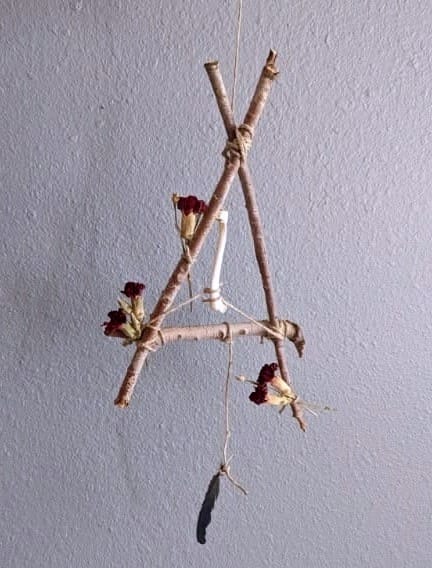
Wards are usually a kind of talisman. A talisman is a small item which is created with the purpose of having magickal significance, and which is then charged through ritual with a specific intention. This talisman is then worn, hung somewhere, buried, burned, or so on depending on its purpose and which tradition you're working in. Wards specifically are talismans which are almost always going to be hung or displayed in a location relevant to their purpose: a doorway, entry gate, property boundary, or so on, and their goal is most often going to be to prohibit entry of those who mean harm – be they incarnate or disincarnate.
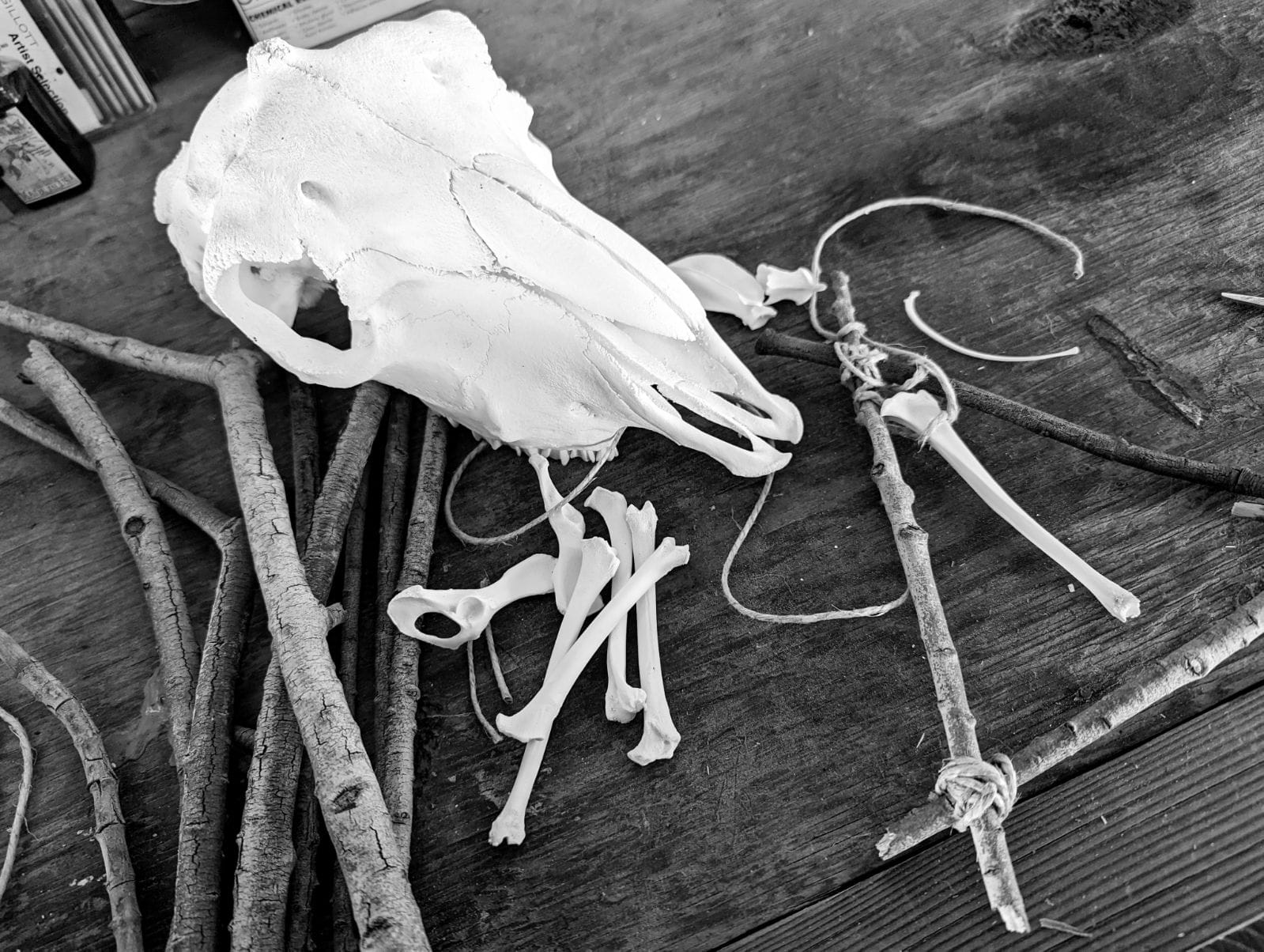
Wards are extremely popular among people who like to purchase items that represent their spirituality, but I'm under the impression that if you buy a ward, unless you take it home and charge it ritually, it won't work. However, there are potentially degrees to this. A ward you purchase from a genuine voodoo-practitioner in a NOLA shop, for instance, will probably[6] have more inherent "charge" than something you grab from a random person on Etsy who may or may not have any basis for making it, but I would still generally recommend bringing it home, performing some kind of clearing, and then additionally charging it with your own, specific intention.
Though wards are often used as tools for exclusion, they are also psychological barriers for other humans as well. Many wards from the American South voodoo or cross-cultural folk magick traditions are intentionally a little menacing: the evil eye wards I create are an example. While the items used, and the shape are not necessarily just "meant" to be scary, it is known that the way they look is alarming to people, and those afraid of curses or other spiritual backlash are likely to steer clear from an area with these present. Obviously there is the great potential for physical backlash, so evaluate likely responses from your community members before being seen hanging such wards in public places.
A ward can be used to strictly "keep away" as its name suggests, or it can be used to "keep away that which..." where the practitioner fills in the blanks. An example could be "keep away that which intends harm to the creatures that reside here". I also create wards that I call "watchers" that kind of came to being spontaneously and the practice of which now continues, which are tied to our fences and which are meant to be a kind of osmotic ward: keep out that which aims to do us harm, but maintain watch for that which helps restore balance and invite it.
Charging wards
For the sake of brevity, I think an in-depth discussion of the ritual charging of talismans in general should be an entire other newsletter. However, the basic principles are as follows:
- Set up a designated ritual space and perform some kind of clearing (or potentially a divination to see if you should go through with the work, depending on tradition).
- Build a charge somehow: different practitioners have different ways of doing this. It may be contained within water that's been charging under the influence of a specific planet or steeped in specific herbs, it may be built through dance or chanting or sex or other methods of working oneself into an ecstatic state, the possibilities here are extremely numerous.
- As you mount into an ecstatic state and become more in touch with the non-physical forces around you, directing them into the ritual space, perform some kind of visualization or directing of those forces into the object.
- Throughout this entire working, the focus should be on the thing that you aim to achieve. With most wards, that is going to be the specific kind of protection or exclusion that is needed.
Banishing
Banishing is a form of protection that is often reactionary, but which has a very similar goal to that of clearing or cleansing. Most often, at least as far as my studies have shown me, banishing is almost always going to be in response to some kind of transgression (the LBRP mentioned earlier is kind of an exception, though it's often used this way as well).
It is complicated to talk about banishing, because as opposed to the prior two methods of protective magick, exactly when and how to banish tends to be hyperspecific to tradition and situation. It is also something I have much less experience with: I often aim to cultivate balance rather than severe exclusion, and so my research on this is fairly limited (and quite frankly, must be done in books. Almost everything I found on the internet about banishing is ridiculous). For this reason, I will share two personal examples of times that I have used banishing rituals, and then offer a summary and some further resources you can go to for more information.
The first situation started when I had my first child. When she was a baby, I started having these terrifying recurring dreams. They always started with me and her having to wade or swim through some kind of body of water: a swamp, an odd lagoon. There were always visual barriers that made navigation difficult: tall reeds, weird docks and building-type things. And at some point, as I struggled to get where we were going and hold my daughter's head above water, we would encounter this being. It was terrifying: gray, smirking. Quite frankly even writing about this and having the image of it in my mind sends chills down my spine and evokes the sensation of being watched. This is the closest thing I have ever experienced to something like possession. These dreams went on for weeks, and progressed in a fashion where at first it would just laugh at me, and I would wake up, and my daughter would wake up moments later screaming. Then it appeared to get closer, and closer, each dream seemingly bringing us closer to real harm. Until I spoke to one of our trained friends about the situation, and then before I even really took action something changed: one dream I was able to turn around and attempt to flee. One, I was able to open my mouth to speak. And then finally, I had a dream where now I was on a raft with my daughter, my partner, and our friend. In the dream, I received a message from our friend, the details of which I now forget but the jist of which was "watch out, but you know what to do now". When the thing appeared in this windy tunnel shortly thereafter, I screamed at it: "leave me the fuck alone!" and when I woke up, my daughter didn't for the first time since we began having this dream.
In this instance, the banishing had to appear on the plane that the visitation was appearing on. I had attempted to conjure the being during meditation, but failed. Perhaps now, in a less fractured physical and mental state and after years more of dedicated Practice, the situation would be different, but then I was at a loss for what to do.
The second situation happened perhaps a year after the first: I started being visited by a being that took the form of an ex-girlfriend of my current partner. I don't think that it was her legitimately (she is still very much incarnate and probably unlikely to be projecting herself to me, someone she only knew very briefly), though the visitations were uncanny: deeply personal information about her was shared with me unsolicited, and strange manipulative suggestions unfolded, as well as incredibly vivid dreams where she would appear in different forms followed by severe and strange imagery. The same friend who'd given me advice about the dream visitor then recommended I start performing the LBRP prior to and after curating a set period of time which this being was allowed to communicate with me. I performed this ritual a few times, invoking the being and attempting to ask it what it wanted. Each time it attempted to claim it was her, and make these odd suggestions, and eventually I simply ordered it to leave me alone, followed up by a final and more in-depth banishing ritual, and it ceased.
Both situations are very different. In one, the banishing was a kind of basic verbal command, and occurred in the realm of the dream in which I was being visited. In the other, I did utilize a ritual from a tradition I don't really follow, but which is incredibly well documented and which there is a lot of symbolic support for as someone raised in a Catholic family and environment. There have been other times, as I have been solidifying my Practice, where I have had to kindly ask things to wait, or leave me alone, or only speak to me if they were really interested in something I could offer without harm to myself. However, since I have curated boundaries as a consistent part of my practice, really "banishing" something has not needed to occur.
I think the takeaway here is that banishing, unless you're someone who performs banishing as a consistent part of your Practice, is an extraordinarily useful tool to eliminate very persistent, unwanted experiences or influences from your work. It is perhaps a tool we should all keep in our toolbelt for when we feel "in over our heads" so to speak, or when that thing we thought would never happen to us does surprisingly. In reality, though, I think truly unwanted persistent visitations are fairly rare and often a signal that perhaps we should slow down. In both cases I was in potentially too fractured a mental state to be engaging in the in-depth workings I was engaged in; and there were other psychological things going on as well[7].
Protective spells
A protective spell is a form of protective magick that does not specifically employ a ward, and which is not necessarily a banishing, but which employs the same basic principles of both of those through different methods and using different symbols. Protective spells fall perhaps outside of the typical realm of ceremonial magick or Western occult traditions and begin to be the purview of either those connected with certain specific Indigenous lineages or those who practice varying forms of witchcraft. They do not necessarily align with the rituals set forth by orders like the Golden Dawn, nor do they fit neatly into many other traditions, but they certainly have their place.
The underlying principles of any protective spell are those that underlie any spellwork: capacity for focus on intention, the crafting of a ritual or object with which to focus this intention appropriately, and the execution of the actions required to raise and direct the energy required.
As an example, the first year that we lived at the Ranch, we had a very odd dispute with some neighbors that are only at their property six or so days per year. At the time, we really weren't sure how seriously to take their threats of violence, and so we were doing the kind of material and legal necessities to protect ourselves but were also engaging in a significant amount of work to avoid certain potential outcomes (having to defend ourselves with force, for instance). I completed both a variant of the clearing ritual I shared above, as well as performed a ritual that included walking the property line clockwise several times while wafting incense, and then burying with the incense a piece of paper that contained writing and images on it relevant to what was going on. This I buried specifically in the part of the property that they were driving across repeatedly, and I included in the burial a few other specific and strategic items.
And it seems to have worked, and I do truly believe that it protected us in the period between the beginning of the conflict and the time that we were able to take more physical actions to end the dispute without violence.
It is hard to offer a baseline ritual for you to try other than that which I just shared. Ultimately what your spells look like is dependent on how you Practice and what it is you need to protect yourself from.
Final thoughts
Protective magick can be extremely useful, both as a tool for expanding and honing your capability and Practice as well as a pragmatic tool for protecting oneself and others. In general, it is wise to consider what it is you need to accomplish when determining which methods are going to be most successful, as well as considering your tradition and its lineage: that which is supported and documented is likely to be more successful and executed more powerfully than that which is being thought up on the spot.
I also recommend always pairing protective magick with physical action when it makes sense to do so. This way, not only are you completing further repetitive action in the direction of your intention (strengthening any magickal work you are doing simultaneously and improving your focus upon the outcome you need), but you are also crafting a kind of safety net should your magick not work as intended.
Magick is not the way it appears in movies and TV shows: results are sometimes less literal and obvious than we'd like, and they are not always instant. Magick works by recognizing the forces that we are emanations or reflections of, and manipulating subtle aspects of those forces in order to shift them very slightly in the direction that we wish them to go. Much like steering a ship, it works best if you are always doing magick in alignment with balance (what some call the Divine Will) as opposed to solely working with yourself in mind. And as always, the more you Practice self-discipline, listening, and focus the more you will find that you are successful in the things that you do.
Thank you for reading, and I look forward to questions and comments should they come up. I hope that this was a valuable read and leaves you with enough material to try on your own if protective magick is not alteady something you often do.
My goal is to release one more article this month for this newsletter, if time permits, on the topic of Death. This piece will take a slightly more freeform approach to the topic, and if it is well received I will potentially begin releasing more symbolically rich and free-flowing pieces on topics that are still relevant to the aim of this publication. As I work on larger pieces of work elsewhere, I find myself wishing to offer something a little more unique than what I have thus far been sharing, in the hopes that such artifacts will contain knowledge in a more assimilable format.
Will all of that, I leave you for now. Until next time ~
Notes
- The term possession and its history and connotation in the English-speaking world is very interesting. I would imagine that most of my readers would probably immediately think of things like The Exorcist, or the very real history of the Vatican engaging in exorcisms against those who were thought to actually be invaded bodily by some kind of demonic presence. Outside of the Catholic/Christian demon/devil language, however, a vast majority of world religions have some kind of concept of possession. Of these, not all of them consider possession inherently negative or detrimental, and possession may be involuntary or voluntary. When I say "possession" here, I am referring primarily to a state of body-mind invasion (or persistent visitation that could feel like a genuine invasion) that is involuntary and negatively impacting of a person's life or emotional state, with the awareness that this is not globally always what this word means. Furthermore, I am not sure that possession is necessarily always what we think it is: while I am inclined to believe that a human being can channel a disincarnate entity in a physical way, as Indigenous adherents to their original faiths have documented and shared, and as there seems to be significant evidence or at least enough anecdotal documentation of such instances that it feels hard to ignore outright, I am genuinely skeptical of the Church's use of the concept of "possession" to psychologically manipulate the Indigenous inhabitants of colonized regions into giving up major aspects of their religious practice. I am also skeptical of the general fear of "being possessed", as I think that it is probably incredibly rare to be genuinely possessed by something that will not leave as a completely random, unprovoked occurrence. What is much more common, though, is repeated "visitation", which is the sense or impression that there is a specific disincarnate being that "won't leave you alone" be that through the presence of voices, images, sounds, smells, physical things happening around you, persistent nightmares featuring this thing, and so on.
- I say "Western occultism" or ceremonial magick because these two things are sometimes the same thing and sometimes not. Western occultism is ultimately a body of knowledge that includes ceremonial magick, but also includes Kabbalistic magick and other avenues of practice that often overlap but not always. Ceremonial magick deserves its own mention within this body of knowledge in this context because it specifically relies on the invocation and evocation of disincarnate entities, be they "angelic" or "demonic" representations of forces, or "spirits" which are thought to be the astral body of once-living humans after death. The Lesser Banishing Ritual of the Pentagram is often recommended in any modern text related to Western occult systems of Practice, but specifically in those related to ceremonial magick because of the perception of increased risk when invoking or evoking certain beings. Furthermore, it is important to note that much of what we consider to be "Western occultism" in the here and now is an amalgamation of what has been disseminated from a few key orders in the 19th and 20th centuries in England and the US, specifically the Golden Dawn (primarily), the O.T.O, and Crowley's A∴A∴. Now that this has been recognized in this footnote, for the purposes of this article, I will continue to generalize a bit.
- I have extremely mixed feelings on Echols and his writing, as well as the entire history of the West Memphis Three and the subsequent publicization therein. While I appreciate the terminology he uses -- and I'm unsure if it's his original terminology or if he gleaned it from somewhere else -- my use of it here is pragmatic and not necessarily an endorsement or recommendation of his writing or personality.
- In different historical ages, different words have been used to describe what we here are calling "energy". While the kind of hokey New Age systems of belief have co-opted this word, and used it for all kinds of spiritual bypassing ("your energy is really off right now bro", "I want to cultivate positive energy in my life"), one could also talk about chi, essence, soul, or other relative equivalencies which all seek to describe that force that pervades all things, and which underlies all movement or occurrence on the physical and nonphysical planes of being. I use energy because it's, I think, most well understood. If I were to say "source" or "soul" I think there would be vastly different interpretations of what I mean when I say that, where I think most modern people are relatively versed in the physics metaphor of "energy" when discussing magick or other spiritual topics.
- There is a difference between the practitioner who engages gods of various pantheons recognizing their symbolic value as representations of different universal or divine forces atop a learned, initiated basis (such as practitioners of Kabbalistic magick who use gods as visualizing aids for varying workings atop the grounded system of Kabbalism) and the one who engages gods of various pantheons as though those gods are beings themselves. The former is likely to be successful and grounded, and the latter may find themselves suffering in a kind of general frustration or confusion around how to synthesize disparate symbolism and myth without a legitimate understanding of the underlying cosmologies and how they relate to the forces we can perceive and affect.
- I actually don't know. I've gifted some friends wards that I've made, but that's quite different than purchasing a "pre-made" ward. Technically, I have wards listed on my ko-fi but have never actually sold one so I have no one to tell me if it is useful or not. I am inclined to believe the Voodoo mistresses when they tell me that their wares work (and this is what has made me believe perhaps mine would be useful to someone as well), but also have the belief that nothing purchased -- even from a master of their craft -- will be as powerful as that which is imbued with your Divine energy. This is one reason why the old grimoires often recommended going to extreme ends to make the items for ritual (besides the fact that some were concealing information in code): forging the sword yourself, and so on. At the same time, I realize that this belief in some ways conflicts with my belief that we are truly all part of one cosmos, and therefore in a way all the same being. For I think the intuitively consistent conclusion based on that knowledge would be that it doesn't matter who makes it, so long as they are following the principles of magick (whatever their discipline, nearly all disciplines have the same basic components for successful magickal practice underneath vastly different actions and symbolism) in a way that is likely to actually produce an effective magickal tool. Perhaps I must ruminate on this further, as I think writing this article is exposing this inconsistency in my own philosophy moreso than anything else has previously.
- In the infinite spaces for questioning "is any of this real or is this all in my head?", both examples were certainly in the camp of "perhaps I'm just making all of this up in my head, but it feels extraordinarily real, so what's the difference?" By this I don't necessarily just mean "whatever feels real is real", because given the right prerequisites we can convince ourselves of quite a lot of nonsense, but truthfully, when it comes to the "realness" of much of spiritual experience there just isn't a way to know beyond intuition. I could have taken the approach of seeking out a psychiatrist and saying that I was hearing voices and having nightmares, but that road leads to medication and a loss of autonomy. That the banishing worked is either a testament to its magickal power or its psychological benefit, and quite frankly it's probably something we should all know how to use either way. I'm certainly one to believe that our sense perception, while flawed, leads us totally astray very little of the time, and that it's beneficial to assume that there is some reality in our experiences even if there is some doubt that could be brought up. Because what good does it really do us to pathologize everything and assume that what is not measurable, necessarily, on the physical plane with the tools we have is not real? With all of this being said, this understanding leads me to be extraordinarily aware, as I've mentioned perhaps ad nauseum at this point, of cultivating the kind of internal awareness that allows me to generate some confidence that I can distinguish between anxiety, jealousy, fear, exhaustion, psychosis, and so on and legitimate audible, visual, tactile, and intuitive experiences. Still, it is likely that I am wrong some percentage of the time, as will we all be until such a point as we have reached some level of total mastery over our craft.
- Excluding Wicca because I know very little about it except that it's perhaps total bullshit. When I say witchcraft I mean land-connected ritual magick, which can be both "high magick" and folk magick.